
Planning your Relocation
Visa and Entry Requirements
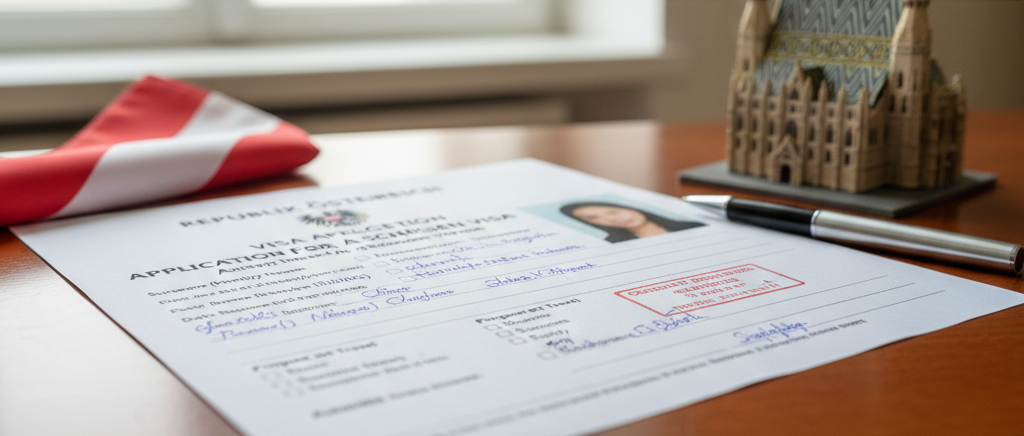
The HR team is dedicated to helping you seamlessly navigate your start at AITHYRA.
We understand that paperwork can sometimes be challenging, so please feel free to reach out to our team if you have any questions. We are also happy to arrange a video call to discuss any concerns and support you through the process.

HR Generalist – Alexander Hage
Visa types
As a researcher you have the possibility to apply for
- a residence permit researcher (Niederlassungsbewilligung Forscher) or
- a Visa D
The preferred visa type is the residence permit (Niederlassungsbewilligung Forscher), however the
application could take 2-3 months. Thus, please apply for a visa D which enables you to work and live in
Austria for the first 6 months of your employment, as it is quicker to get (in some cases, it can be possible to
start both concurrently). As a researcher you are always allowed to extend your visa/residence permit in
Austria – regardless of the visa status – and you do not have to travel back to your home country to extend
your stay. Once you arrive in Austria, we can make an appointment for the residence permit application.
Where to hand in the visa/residence permit application
You can use the link to find the Austrian embassy in the country where you are currently residing and submit your visa application.
Please contact our colleague Patrycja Johansson (pjohansson@aithyra.at) ; she is happy to book your journey to the embassy; in case it is needed.
Are you coming for an interview? – Short-Term Visit – Visa C
Are you visiting Austria for less than 90 days?
Learn more about Short-Term Visa
The Schengen visa C is intended for touristic, business or visiting purposes (without gainful employment) for a maximum stay of 90 days per 180 days.
Each application for a visa is subject to a case-by-case examination by the competent Consulate.
Holders of a Schengen visa are in principle entitled to enter and stay in the Schengen States presumed that the requirements of Art. 6 Schengen Borders Code are fulfilled and the visa is not subject to territorial restrictions.
The Schengen States are:
- Austria, Belgium, Croatia, the Czech Republic, Denmark, Estonia, Finland, France, Germany, Greece, Hungary, Italy, Latvia, Lithuania, Luxembourg, Malta, the Netherlands, Poland, Portugal, Slovakia, Slovenia, Spain, Sweden, and the non-EU members Switzerland, Norway, Iceland and Liechtenstein.
Find your nearest Austrian consulate
Documents required:
- Passport
- Biometric photo
- Completed visa-C form
- Travel booking confirmation
- Health-insurance proof (we will provide the insurance policy)
- Invitation letter
Expected processing time:
From our experience, a C‑type visa is usually issued within 1.5 – 3 weeks after you submit the complete application.
Secured a Work Contract with AITHYRA? – Long-Term Stay – Visa D
Learn more about Long-Term Visa
Visa D, national visa, are subject to national legislation and which entitles the holder to stay in Austria for a period of 91 days up to six months. They can be issued for single or multiple entries.
A Visa D also entitles the holder to move about in the territory of the other Schengen member states for up to 90 days per period of 180 days, given that the holder has a valid travel document and fulfils the entry requirements according to the Schengen Border Code.
Documents required:
- Visa D Form
- Biometric passport photos: New pictures!
- Valid passport: Please note that your passport has to be valid for at least 1 more year.
- Please copy all pages of your passport where entries were made.
- Please prepare a list of the countries you have travelled to in the last 6 months (destination – date when you entered the country + date when you left the country, including your journey to Vienna), and sign the list.
- If you had a visa/residence permit in Europe before: please prepare copies.
- Employment contract, prepared by AITHYRA (or your place of employment)
- Rental contract or room confirmation provided by AITHYRA (in case you receive your visa appointment before you get a confirmation, please let us know and we will provide you with a letter in the meantime)
- Aufnahmevereinbarung/hosting agreement (prepared by AITHYRA or your place of employment, completed form).
In addition, the following documents will be needed once you are Austria to receive a residence permit:
- criminal record (of the country you have been living in before)
- Please also have your most recent university diploma
Most likely, for a visa D the visa officer will also not ask for your diploma and the criminal records. However, in case you apply for a visa D please do also obtain these documents before moving to Austria as you will need them to change to a residence permit. The form for the visa D application can also be found on the Austrian embassy’s website.
Please note that as a researcher you never need a confirmation from the AMS (Arbeitsmarktservice)
and you do not need to show a flight ticket for a round trip. The hosting agreement
(Aufnahmevereinbarung) replaces these documents.
Expected processing time:
Normally, the visa D application is rather fast. Experience showed that it takes approximately 2-3 weeks
until you receive the visa D sticker for your passport.
The residence permit application takes normally 10 weeks (=> 8 weeks processing time at the immigration service office + 2 weeks preparation time to compile all documents).
Next steps
- Please make an appointment with the Austrian embassy and pass on date/time/location to our team
- Please compile all the necessary documents for the visa application.
Please note that for some countries you are required to immediately apply for a residence permit for researchers. Please get in touch with our HR department.
Residence Permits extensions
Settlement Permit – Researcher
The “Settlement Permit – Researcher” is for non-EEA individuals:
- With a doctoral/PhD degree or equivalent
- Or a degree allowing access to doctoral/PhD programs
- Who plan to conduct research in Austria requiring this level of qualification
Additionally, a Hosting Agreement with a certified research institution is required. You can apply for the Settlement Permit Researcher in your country of residence (processing takes up to 3 months) or in Austria after legal entry.
It is generally issued for 24 months.
Please note: If you enter with a VISA C or are eligible for visa-free entry, you may not start your research work until your Settlement Permit Researcher has been granted (processing takes up to 8 weeks).
Red-White-Red plus Card – after 2 years
Qualified workers who are non-EEA citizens can apply for the Red-White-Red Card. This residence permit is criteria-based and each criterion is given a certain number of points. It is issued for 24 months.
The employer must issue an “Employer’s declaration”
You can apply for the Red-White-Red Card from your country of residence
If you have a job offer and fulfill the criteria for “Very Highly Qualified Workers” (general criteria plus minimum 70 points), you can apply in Austria after legal entry (with a visa)
Useful Resources for Visa & Entry
Information for Families

Family Reunification
If family members can join you in Austria once you have obtained a residence permit depends on different factors, mainly what kind of title you hold.
Important: Many authorities require the submission of a current extract from the criminal record as part of an initial application (for people 14 years or older). The record should not be older than 3 months and translated if not in English or German.
Learn more about family reunification options:
Childcare & Schools
Day Care
Children between ages 0 and 6 can receive free childcare and early education in Vienna at public kindergarten. You only have to pay for meals and additional activities. To be eligible, at least one parent and the child must be registered in Vienna and the parents must show proof of employment or education.
The new kindergarten year starts in September. Register your child between the beginning of November and the end of December the year before.
Schools
Austria has a free public school system. Compulsory education for all children permanently living in Austria starts at age six and lasts for nine years. There is also a mandatory kindergarten year that prepares the child for school.
The school year starts in early September and ends early in July. Most schools have “Open Door Days” every year in fall.
Useful Resources for Families
Financial Support for Families
Family Allowance
The Family Allowance is issued automatically if the child is born in Austria. Otherwise, you need to apply for it at the Fiscal Authority (FinanzAmt), online through FinanzOnline, or by mail.
The allowance is for minors up to age 18. For persons older than this, the family allowance is paid under certain conditions (e.g., vocational training).
Family Bonus Plus
The “Familienbonus” (Family Bonus Plus Benefits) is a tax allowance reducing payable tax by up to 2,000 Euros per child and year, provided the child is receiving family allowance benefits.
The family bonus plus benefits can be received as monthly tax relief through payroll accounting or annually through the tax declaration.
Useful Resources
Accommodation
Finding Accommodation
The best way to look for housing is after arriving in Vienna. This way you can check out the different districts and connections to your workplace before choosing your new place to live. There are good short-term housing options available.
Short-term Accommodation Options
- Room4rent – Short-term apartments (2 months-2 years)
- Milestone – Student apartments
- My Wien Apartment – Furnished apartments for stays ranging from 7 months to 2 years
- HousingAnywhere – Platform for finding apartments from abroad
Long-term Housing Options
You can rent an apartment or house via an agency or directly from private landlords. In either case, you will typically be asked to make a deposit of 3 monthly rents.
Important: Don’t forget that you need to change your Registration (Meldebestätigung) when moving in or moving to a new apartment.
Must-Know When Renting
- Deposit (Kaution): Usually 3 months’ rent, returned when moving out in proper condition
- Operating Costs (Betriebskosten): Include waste disposal, lighting, elevator, maintenance – evaluated yearly
- Fully Equipped: The apartment should come with a functional kitchen (stove, oven, fridge, cabinets, etc.)
- Household Insurance: Strongly advised – protects belongings and includes liability protection
- Tenant’s Associations: MieterHilfe Wien offers free consultations for tenants
Housing Platforms
- Flatbee.at – Commission free housing options
- Willhaben.at – Austria’s biggest online marketplace
- Immobilien.net – Real estate platform
- WG-gesucht – Platform for flat-sharing and apartments