Here’s a quick rundown of the key trends in Machine Learning research from the past week.
💫 Key Research Trends This Week
This week’s research primarily focuses on various aspects of AI safety, ethical considerations in generative AI, and the reliability of autonomous AI systems.
Researchers are developing automated frameworks for tracking and understanding AI failures, as seen in Automating AI Failure Tracking.
There’s a growing examination of the ethical implications and increasing use of Large Language Models (LLMs) in news creation, as highlighted in Echoes of Automation.
Concerns are being raised about hidden pitfalls and the need for transparency in autonomous AI scientist systems to ensure reliable research outcomes, detailed in The More You Automate, the Less You See.
🔮 Future Research Directions
Future research will likely expand on AI safety, the societal impact of generative AI, and the trustworthy development of autonomous AI agents.
Expect continued development of advanced tools and methodologies for proactive AI incident detection and mitigation.
Increased scrutiny and regulatory frameworks for AI-generated content in sensitive areas like journalism are anticipated.
Further efforts will focus on building more transparent and auditable AI research systems to guarantee the integrity of scientific outputs.
This week’s trends underscore a critical pivot towards ensuring the safety, ethical deployment, and reliability of increasingly autonomous AI systems. Look for upcoming developments in robust AI safety protocols and clearer guidelines for AI-generated content.
Here’s a quick rundown of the key trends in Machine Learning research from the past week.
💫 Key Research Trends This Week
This week’s arXiv publications highlight significant progress in Retrieval-Augmented Generation (RAG), with a focus on systematic reviews, AI incident tracking, and efficient model deployment.
Research is advancing on combining reasoning and RAG within lean language models, enabling performant and privacy-preserving solutions for resource-constrained environments Retrieval-augmented reasoning with lean language models.
🔮 Future Research Directions
Future research in AI and ML is poised to focus on refining RAG systems for improved performance, robustness, and ethical considerations, alongside developing more efficient and specialized AI applications.
Expect continued exploration into novel RAG architectures and evaluation methodologies, building upon existing systematic reviews to address identified gaps.
Further development in AI safety and responsible AI practices, particularly in automating the identification and mitigation of AI failures.
Increased efforts in optimizing and deploying lean RAG models for diverse applications, emphasizing efficiency, privacy, and domain-specific reasoning.
This week’s updates underscore the rapid evolution of RAG technologies and their expanding applications across various domains, from enhancing conversational AI to bolstering AI safety. Look out for new developments in scalable and efficient AI systems, along with continued innovation in integrating ethical considerations into AI development.
Here’s a quick rundown of the key trends in Machine Learning research from the past week.
💫 Key Research Trends This Week
This week’s research highlights significant advancements in making Large Language Models more efficient, expanding the capabilities of generative and multi-modal AI, and enhancing the trustworthiness and applicability of AI in real-world scenarios.
Advancements in Generative and Multi-Modal AI: Research continues to push the boundaries of generative models, with developments in scalable methods for high-resolution image synthesis as demonstrated by Scalable Generative Models for High-Resolution Image Synthesis, and breakthroughs in multi-modal foundation models capable of understanding and generating diverse content across text, image, and audio, exemplified by Advances in Multi-Modal Foundation Models.
Applied AI for Trustworthiness and Deployment: There’s a growing emphasis on practical AI applications that prioritize crucial properties like privacy and robustness, including federated learning for privacy-preserving healthcare analytics in Federated Learning for Privacy-Preserving Healthcare Analytics, and techniques to improve adversarial robustness in computer vision models as discussed in Adversarial Robustness in Computer Vision Models.
🔮 Future Research Directions
The trends from this week’s publications suggest a future where AI models are not only more capable but also more efficient, reliable, and ethically sound.
Expect continued breakthroughs in model compression and novel architectures that make large AI models more accessible and deployable on diverse hardware.
Look for further integration and sophistication in multi-modal AI, enabling seamless interaction and content generation across various data types.
Anticipate an increased focus on robust, interpretable, and privacy-preserving AI systems, especially as AI integrates into sensitive sectors like healthcare and finance.
This week’s insights underscore the ongoing drive towards more efficient, versatile, and trustworthy AI. Keep an eye out for further developments in the optimization of large models and the expansion of multi-modal generative capabilities in the coming weeks.
This report provides a comprehensive bibliography and analysis of the most relevant and up-to-date sources regarding the AITHYRA Research Institute for Biomedical Artificial Intelligence as of August 12, 2025. The AITHYRA Institute, founded in 2024 and based in Vienna, Austria, is rapidly emerging as a leading center for AI-driven biomedical research. This report evaluates each recommended source for its relevance, reliability, and significance in addressing the latest developments at AITHYRA, including institutional milestones, leadership appointments, research initiatives, symposiums, faculty recruitment, and collaborative programs.
The sources are organized thematically and presented in a structured manner, with each entry analyzed for its contribution to understanding the current status and activities of AITHYRA. All sources are hyperlinked for direct access.
The official website is the primary and most authoritative source for institutional news, mission statements, and ongoing updates about AITHYRA. It provides direct access to announcements, open positions, and event information.
Reliability:
As the official portal of the Austrian Academy of Sciences (ÖAW), this source is highly reliable for factual and up-to-date information.
Significance:
Key for understanding the foundational goals, structure, and current activities of AITHYRA, including its location at the Vienna BioCenter and its focus on integrating AI with life sciences.
Key Facts:
Founded in 2024, operational at Marxbox, Vienna BioCenter.
Mission: Transform life sciences with AI, aiming for biomedical breakthroughs.
Supported by the Boehringer Ingelheim Foundation and the City of Vienna.
Announces the launch of AITHYRA, highlighting leadership appointments and the strategic partnership with CeMM (Research Center for Molecular Medicine).
Reliability:
Published by CeMM, a key partner and reputable research institute.
Significance:
Details the appointment of Michael Bronstein (Scientific Director, AI), Anita Ender (Managing Director), and Georg Winter (Scientific Director, Life Sciences). Emphasizes the collaborative environment at Vienna BioCenter and funding structure.
Key Facts:
Michael Bronstein (DeepMind Professor, Oxford) is the founding director.
Anita Ender bridges AITHYRA and the medical campus.
Georg Winter, previously at CeMM, is the deputy director for biomedicine.
Provides real-time updates on faculty recruitment, PI appointments, and institutional milestones.
Reliability:
Official LinkedIn page, managed by the institute.
Significance:
Recent posts (August 2025) confirm the onboarding of new Starting Principal Investigators, including Ariane Mora, and outline plans for further faculty expansion.
Key Facts:
Ariane Mora, computational biologist and AI researcher, joins as Starting PI in November 2025.
Over 250 applications received for initial PI and Robotics Lab Head positions.
New faculty members to be announced in the coming weeks.
Details the flagship international symposium organized by AITHYRA, a major event in the institute’s calendar.
Reliability:
Official event page on the ÖAW/AITHYRA website.
Significance:
The symposium, now fully booked with 350 attendees, showcases AITHYRA’s role as a hub for global experts in AI and life sciences. The program features Nobel Laureate Frances H. Arnold as keynote speaker, and a roster of renowned scientists.
Key Facts:
Dates: September 8-10, 2025, at Vienna’s House of Industry.
Registration fee: €150; registration closed due to high demand.
Speakers include leaders from Caltech, Columbia, MIT, Harvard, Stanford, and more.
Focus topics: AI-driven drug discovery, genomics, single-cell biology.
Announces the launch of a major PhD program jointly run by AITHYRA and CeMM, starting January 2026.
Reliability:
Backed by official calls and cross-referenced on AITHYRA and CeMM platforms.
Significance:
Signals AITHYRA’s commitment to training the next generation of interdisciplinary scientists, with a focus on AI/ML applications in molecular medicine.
The AITHYRA Research Institute for Biomedical Artificial Intelligence is at a pivotal stage of growth and international recognition as of August 12, 2025. The sources reviewed above collectively provide a multifaceted and up-to-date picture of the institute’s latest developments:
Institutional Growth: AITHYRA is now fully operational at the Vienna BioCenter, with a new building planned.
Leadership: The appointment of world-class directors and the onboarding of new faculty, such as Ariane Mora, signal a strong foundation.
Symposium: The upcoming “AI for Life Science” symposium is a major event, attracting global leaders and highlighting AITHYRA’s research agenda.
Recruitment: Active hiring for both scientific and administrative roles, alongside a competitive PhD program, demonstrates rapid expansion.
Research Focus: Emphasis on AI/ML integration in molecular medicine, with applications in cancer, immunology, and neurodegeneration.
Community Engagement: Regular updates via LinkedIn and partner platforms ensure transparency and broad engagement.
For anyone seeking the latest news and developments at AITHYRA, the above sources are essential. They offer reliable, timely, and in-depth coverage of all major aspects of the institute’s activities, leadership, and scientific direction.
Both the Large Language Models and our Chat interface, based on “Open WebUI” are still changing often. To provide you with latest information about these changes, I compiled this short article.
New models
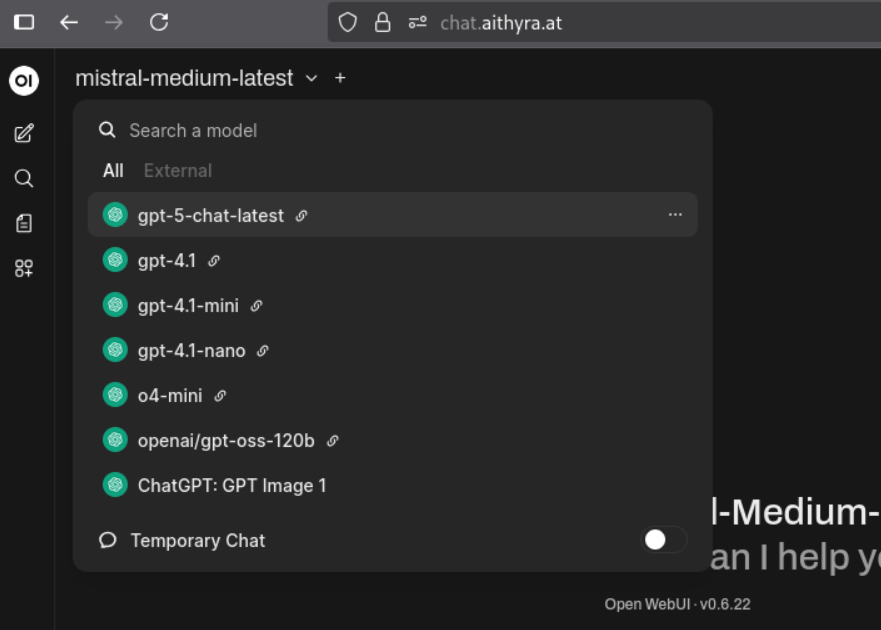
You probably have read about GPT5 in the news, and the model is also available in our AITHYRA Chat as “gpt-5-chat-latest“. Please be aware, that this model is a “one-fits-all” approach, which is choosing the real model (gpt-5, gpt-5-mini, gpt5-nano) depending on your prompts. We are working on getting the real models as well, which will allow you to choose!
Another new model is the “openai/gpt-oss120b” model, which is an open-source model by OpenAI which allows us to run it on our own servers (in the near future). This not only means there are no additional API costs using it and most importantly all data stays local, which allows the model to be used for sensitive data. We’ll soon provide more local running models.
Chat GUI Changes
The latest version introduced one major interface change: a “guided response regeneration menu”.
This could be helpful for some, but you can easily configure the “old” behavior, where it regenerates immediately.
Just click on your user-icon, select “Settings” and “Interface”. Now scroll to “Regenerate Menu” and disable it.
Now you can easily switch model and regenerate the response with a single click!
Prompting tips
We added some basic AITHYRA knowledge to AITHYRA Chat, which you can easily access by starting your chat with:
#AITHYRA
In this video I’m enabling the “AITHYRA Collection” which are the current documents from our homepage at OEAW as well some policies and other documents. You can chat with any model on this knowledge and ask different questions.
If you are lucky, they will tell you if they don’t know about something and not invent an answer!
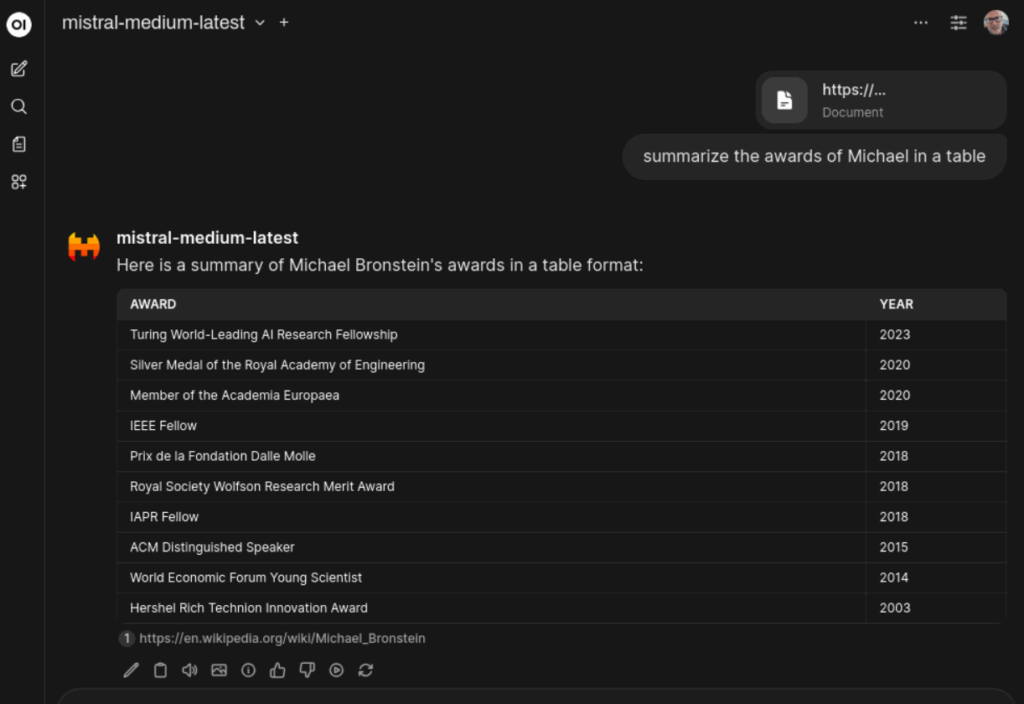
And ask a model to provide some information about this page.
As some (many) pages are optimized to be viewed with a browser, this method does not always deliver reliable results, as they sometimes do not provide the text in a pure machine-readable format.
Alternatively you can use the Web-Search to get current information:
How to detect AI generated content
The Wikipedia people just published a very comprehensive article to find out if some content has been created with (Gen)AI.
It’s an interesting article to find out if something you got sent is AI, but also provides information what to avoid if you use AI to help you with your documents!
Here’s a quick rundown of the key trends in Machine Learning research from the past week.
💫 Key Research Trends This Week
This week’s research highlights include advancements in benchmarking interpretable AI models, developing conceptual schema languages for knowledge graphs, and applying novel transformer architectures to multivariate time series analysis.
Benchmarking efforts are underway to assess the generalization and robustness of Concept Bottleneck Models (CBMs) in computer vision, especially against distribution shifts, as seen in SUB.
New conceptual schema languages, like the one proposed for knowledge graphs in The KG-ER Conceptual Schema Language, are emerging to describe the structure and semantics of knowledge graphs independently of their representation.
Research is exploring advanced transformer architectures, such as hierarchical hypergraph transformers, for multivariate time series analysis to better model complex interactions, exemplified by HGTS-Former.
🔮 Future Research Directions
Future research directions are likely to build on improving AI model reliability, enhancing data management, and exploring new deep learning applications.
Expect continued work on making interpretable AI models more robust and reliable in diverse real-world scenarios.
Further development of schema languages for knowledge graphs will likely focus on capturing more intricate semantics and integrating across different data representations.
The application of sophisticated transformer models, particularly those leveraging graph structures, to time series and other complex relational data will continue to expand.
This week’s updates show a push towards more reliable, better-structured, and highly analytical AI systems. Next week, keep an eye out for further innovations in AI interpretability, knowledge representation, and novel deep learning architectures.
Here’s a quick rundown of the key trends in Machine Learning research from the past week.
💫 Key Research Trends This Week
This week’s research highlights advancements in computer vision model generalization, cross-modal learning for medical applications, and novel approaches to multivariate time series analysis.
Future research will likely emphasize building more robust and interpretable AI systems, especially in sensitive domains like healthcare, and continue to innovate in handling complex, high-dimensional data.
Expect continued development of robust benchmarking datasets and methods to assess and improve the generalization capabilities of interpretable AI models, particularly under distribution shifts.
Further exploration of adaptive and efficient cross-modal learning frameworks will be crucial, especially for medical AI, to better integrate diverse data types without relying on large quantities of hard negative samples.
The application of advanced graph-based neural networks and transformer architectures will expand to tackle the complexities of multivariate time series and other highly-dimensional, interactive datasets.
This week’s digest shows a clear push towards more reliable, interpretable, and adaptable AI systems, alongside sophisticated methods for handling complex data structures. Look for continued innovations in model generalization, efficient multi-modal integration, and novel architectural designs for intricate data analysis in the coming weeks.
Here’s a quick rundown of the key trends in Machine Learning research from the past week.
💫 Key Research Trends This Week
Recent publications highlight several prominent directions: enhancing AI safety through automated incident tracking, optimizing user experience with data-centric AI, and integrating LLMs into multi-agent systems.
One key trend is the application of Retrieval-Augmented Generation (RAG) and semantic similarity for enhanced AI safety and incident tracking, as seen in Automating AI Failure Tracking.
Another trend involves the development of sophisticated data-centric AI solutions to optimize personalized user experiences and navigation on large-scale online platforms, exemplified by KLAN: Kuaishou Landing-page Adaptive Navigator.
The integration of Large Language Models (LLMs) to enhance the capabilities and architecture of multi-agent systems, particularly in geosimulation, marks an important development in Agentic AI, highlighted by A survey of multi-agent geosimulation methodologies.
🔮 Future Research Directions
Looking ahead, the research community appears poised to:
Expect continued advancements in applying semantic similarity and RAG techniques for robust AI safety monitoring and mitigation.
Future work will likely focus on more adaptive and intelligent personalized recommendation systems, leveraging data-centric approaches to optimize user journeys across diverse digital platforms.
Research will further explore and formalize the architectural integration of LLMs within multi-agent systems to enable more complex and intelligent agent behaviors in various simulation and real-world scenarios.
In summary, this week’s research underscores a move towards more reliable, user-centric, and intelligent AI systems. Look for continued innovations in AI safety frameworks, personalized platform experiences, and the expanding role of LLMs in multi-agent architectures.